“Nature Is a Temple 2”
On View at Collect Open 2026
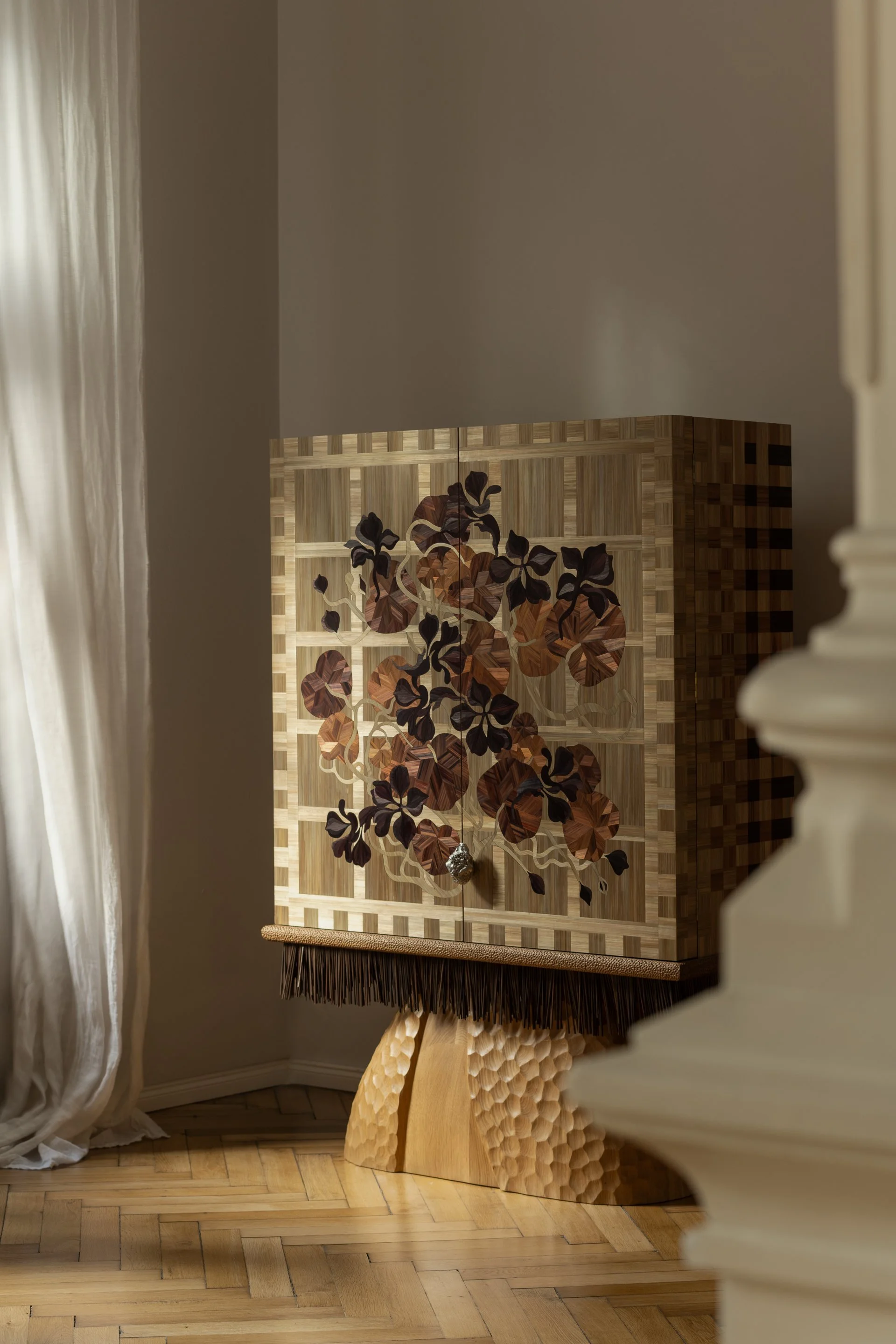
I am delighted to present my newest cabinet and mirrors at Collect 2026 at Somerset House, London.
This presentation marks a continuation of my exploration of straw marquetry and the cabinet as a narrative object.
-
The cabinet continues the language introduced in Nature Is a Temple, developed here through a new image, pattern composition, wood selection and chromatic palette. It refines the formal and material vocabulary while maintaining the structural clarity of the original work.
-
The mirrors develop softer forms rooted in the archetype of the frame. Their deconstruction reexamines the object’s conventional function.
-
Displayed here are material studies and 3D prototypes that investigate new structural and formal directions. They form an integral part of the ongoing development of the work.
-
The title Nature Is a Temple comes from the sonnet “Correspondences” in the volume Les Fleurs du mal by Charles Baudelaire*. The poem describes nature as a space of signs — a system of relationships in which matter and meaning remain inseparable.
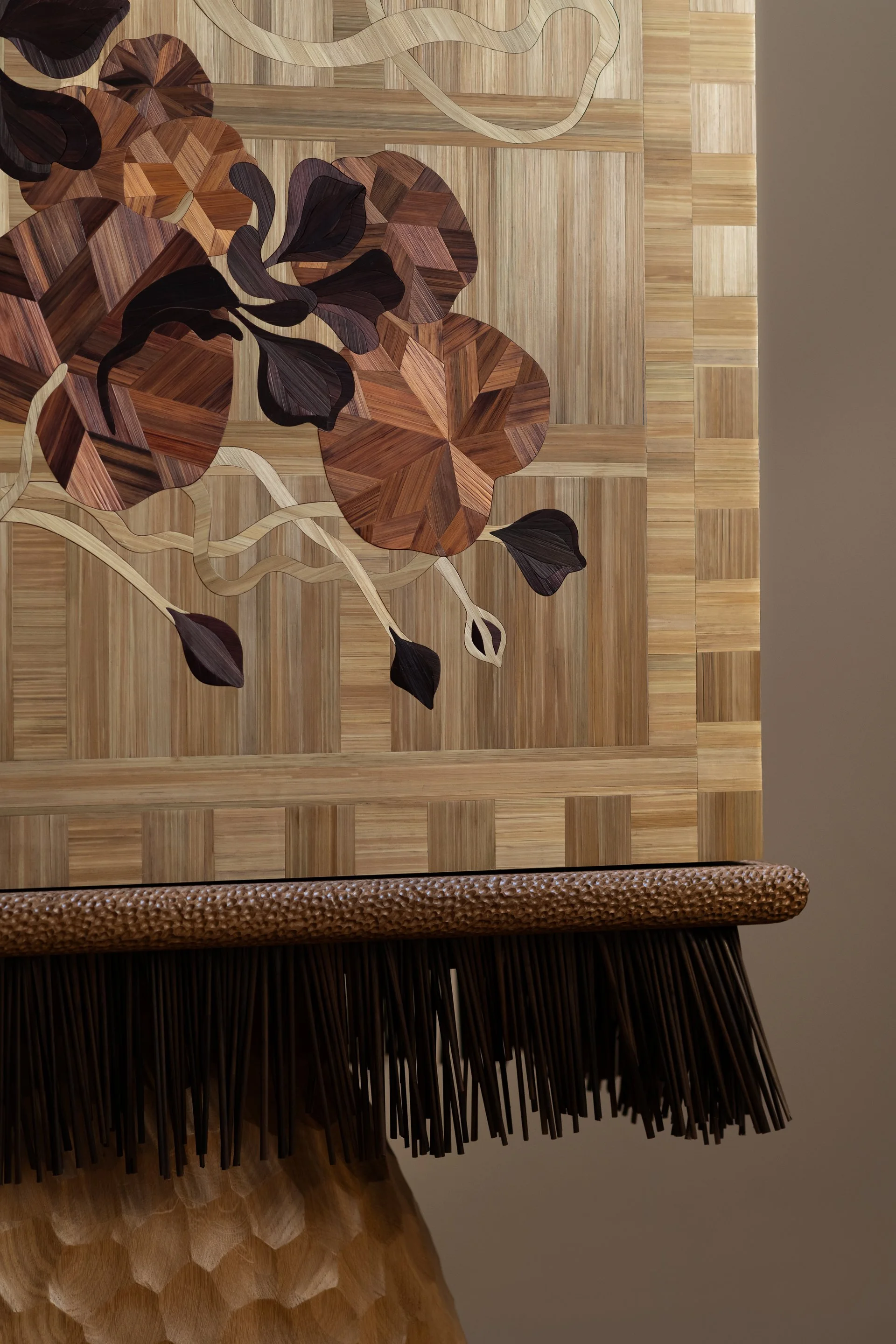
The cabinet presented here continues an earlier edition bearing the same title. The pansy motif has been replaced with nasturtiums — among the field flowers that Stanisław Wyspiański elevated to monumental scale in his polychromes for the Franciscan Church in Kraków. Within the Gothic, vertical space of the temple, he placed soft, rural plants: pansies, poppies, dandelions, nasturtiums. This gesture was not a decorative quotation of nature but a shift in hierarchy — the introduction of a motif considered commonplace into a culturally privileged space.
For centuries, straw was a fundamental material of the Polish countryside: used for roofing, insulation, weaving vessels and everyday objects. At the same time, in 19th-century France, straw marquetry became a luxurious furniture finish created for bourgeois interiors.
The project brings these two orders together.This moment of tension forms one of the key reference points for the project.
A vernacular raw material is employed in a technique historically associated with bourgeois culture and then embedded in the typology of the cabinet — a representative piece of furniture found primarily in affluent homes.
The marquetry surface is constructed from hand-split, pressed, and individually fitted rye straw.Its natural wax layer gives it a subtle sheen. The nasturtium motif is composed of hundreds
of precisely joined elements.
The smoothness and luminosity of straw are set against hand-carved oak and walnut.
The wood retains the trace of the tool, its roughness and weight. This juxtaposition does not serve decorative contrast; it reveals differences in their cultural and social origins.Peasantomania and Its Ambivalence
For a British audience, a natural reference point may be the Arts and Crafts movement — a return
to craft as an ethical response to industrialization. Polish peasantomania, developing at the same time, had a different dimension. It concerned not only production or aesthetics but social relations
in a country deeply divided along class and political lines.Nature Is a Temple does not reconstruct peasantomania nor romanticize its tensions. Rather,
it asks whether a material rooted in rural everyday life can function within a bourgeois typology without losing its identity — and without submitting to its symbolic hierarchy. -
Item description
-
Item description
-
Item description