about
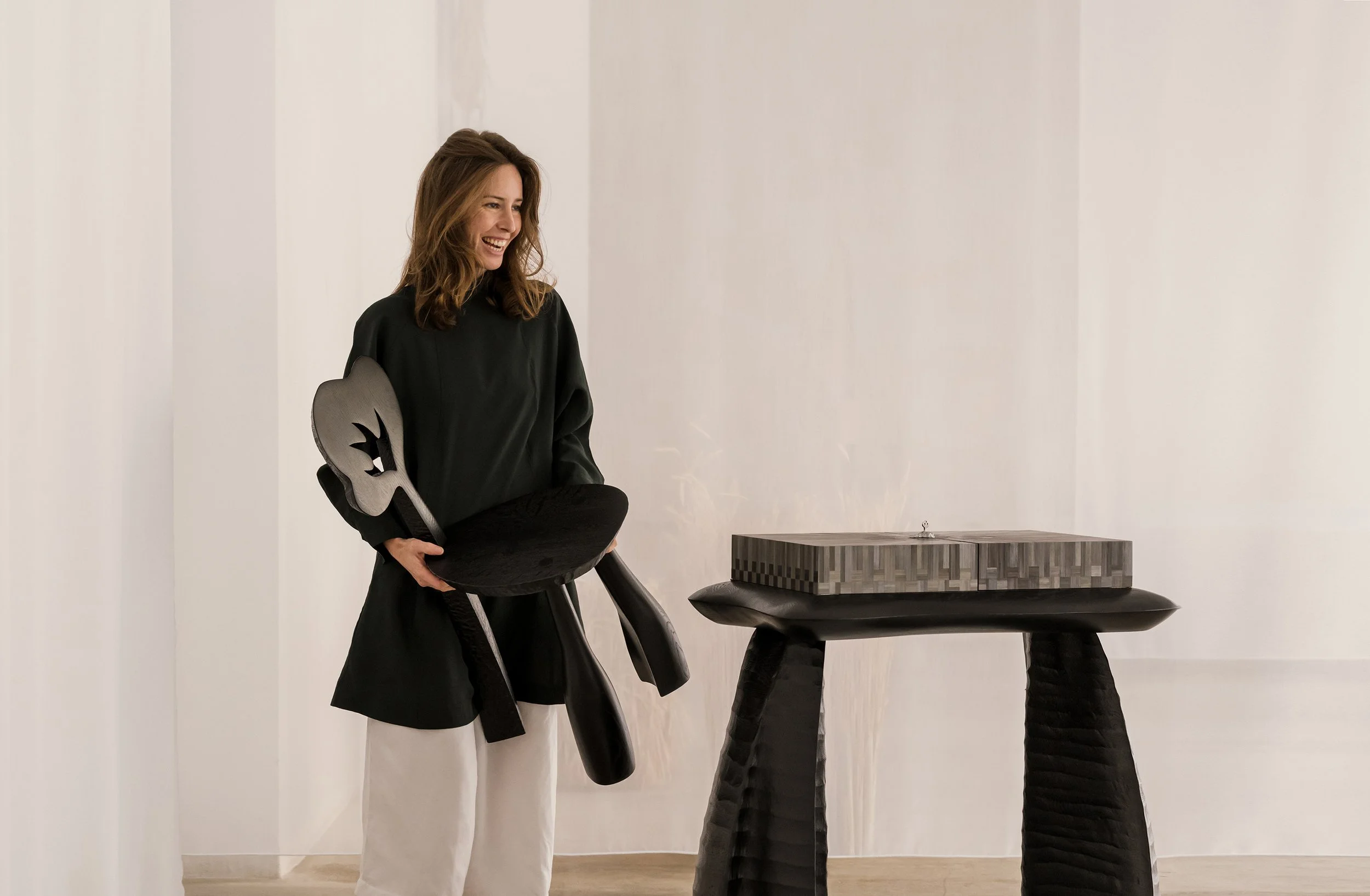
Zofia Sobolewska Ursic is a Polish artist and designer working between functional art, material research and contemporary craft. Her practice centres on sculptural furniture and functional objects shaped by the interplay of material, form and cultural memory, with a focus on straw intarsia, carved wood, woven metal and, lately, stone.
She has been selected for Collect Open 2026 at Somerset House in London, where she will present a new installation of straw-intarsia works. She is also developing stone-based sculptural pieces within the Shakti Design Residency in India, created in collaboration with the Jaipur atelier Frozen Music, with her debut to be shown at Alcova 2026 during Salone del Mobile.
She trained in straw marquetry at Atelier Lison de Caunes in Paris, and her works have since been exhibited internationally at Salon Art + Design in New York, NOMAD St. Moritz, and Milan Design Week 2025.
Sobolewska Ursic studied architecture at the Universität für angewandte Kunst Wien, working under the mentorship of Wolf D. Prix, Zaha Hadid and Greg Lynn — an experience that continues to shape the spatial and sculptural dimension of her practice.
Material remembers — straw remembers, stone remembers. Not only histories, but emotions too. And I simply try to shape them.
-
Pastoral Posture
Marking the move from the heavy ornamentation of the Victorian era into the geometric purity of high modernism, the early 20th century Art Nouveau style emerged as a means of mitigation. Its proponents sought to temper the technological developments of the second industrial revolution by reintroducing naturalistic motifs and reimplementing the long-established craft practices that had all but been rendered obsolete by these innovations. Others sought to utilize this romanticized interlude as a way of reestablishing distinctive identities, especially on a collective level.
In Poland, the movement coincided with Chłopomania (peasant-mania): a movement defined by the largely superficial appropriation of rural life, a closer connection to nature and tradition, by urban elites in order to cement an otherwise fractured national image. The country had been marked by a long period of geographic division and foreign invasion. This condition would continue to shape its position well into the 20th century.
Multivalent creative Stanisław Wyspiański sought to explore this zeitgeist on a far more intrinsic level: harnessing folkloric symbolism as a way to scrutinize the existential dimensions of self-determination. He challenged previous attempts that were ineffective in this effort; ones that pejoratively pigeonholed countryfolk as naive. In contrast, the avowed interdisciplinarian endeavored to fully celebrate this marginalized population as the truest embodiment of Polish virtue and resilience.
In works like Wesele, a play recounting the wedding of a peasant woman to a member of Kraków’s intelligentsia, Wyspiański sought to expose the feeble link between urban elites and the farmers they were outwardly aiming, but ultimately failing, to incarnate. Much of the scenography incorporated hyperbolized symbolism as a form of satire.
For contemporary designer Zofia Sobolewska Ursic, a creative polymath in her own right, it's the honest, almost scientifically accurate, floral motifs Wyspiański painted within Kraków’s Basilica of St. Francis of Assisi, that drew her to his oeuvre. “Somehow these decorative panels don’t fit within the environment,” she explains. “I’ve always found the critical tension fascinating.”
Contrast is a preoccupation that has defined a large part of her career, balancing her training in contemporary design technologies at university with an apprenticeship in straw marquetry at the Ateliers Lison de Canes, successor to noted French Art Deco-era master André Groult. Juxstaposition, in both material and technique, is something that she continues to harness as a way of articulating deeper meaning and communicating relatable narratives. Sobolewska Ursic achieves plausibility by anchoring and distilling these explorations in decipherable forms: recognizable furnishings and objects.
“Straw is a material with many dimensions,” Sobolewska Ursic says. “It was historically used as thatched roofing and insulation for rural homes. As marquetry, it has long been used as a luxurious surface treatment. One application is durable. The other is delicate.”
It undergoes a metamorphosis. It begins as a humble crop but is transformed into a sumptuous material. This might very well be the most profound and succinct, yet subtle, demonstration of what Wyspiański ultimately hoped to express, the intrinsic expression of the peasant as the most authentic embodiment of Polishness.
In an homage to his work and inherent advocacy, Sobolewska Ursic has developed a holistic capsule collection of functional artworks that fully incarnate the contrast between symbolic folklore and bourgeois furniture.
Cabinets, room divider screens, and various other furniture typologies have been adorned in innovatively cut and intricately applied straw marquetry motifs. Roughly hewn and chiseled blocks of wood, the foot of cabinets and feet of tables, serves as the contrasting element, indicating an apparent yet nuanced degree of tension, much like the scenography of Wyspiański’s Wesele play.
There is something manifestly Art Nouveau in this undertaking, not merely as nostalgic interpretation or social commentary, but also as means of slowing down the ceaseless and unregulated forward-march of technological advancement. In a time when fears about AI’s dominance become increasingly justified, there’s a collective desire for the familiar and tangible. There’s a growing need to collect physical objects that have true personal resonance rather than those that outwardly assert aspirational conformity.
And yet, there’s less of a need to exhibit these mementos in a conspicuous fashion as they might have been in the ostentatious homes of Kraków’s early 20th-century intelligentsia. Cabinet doors were traditionally configured with glass panes so as to fully display the items inside; to demonstrate one’s prosperity and knowledge. Conversely, Sobolewska Ursic’s cabinets are entirely enclosed and its contents fully concealed.
__
Adrian Madlener is a Brussels-born, New York-based journalist specializing in collectible and sustainable design. With a particular focus on topics that exemplify the best in craft-led experimentation, he has frequently contributed to publications such as Architectural Digest, Cultured, Domus, Dezeen, Dwell, Hypebeast, FRAME, and Wallpaper*. Madlener has also written monographs—on Italian polymath Vincenzo De Cotiis and Czech architecture firm Chybik + Kristof—and curated exhibitions on American design history, contemporary glass, counterfeit culture, and tool theory. He’s consulted for numerous architecture firms, design brands, and cultural institutions. He recently co-founded design criticism substack EXT.RUDE.D. Madlener holds degrees from the Design Academy Eindhoven and the Parsons /Cooper Hewitt History of Design MA program.
-
Solo shows:
2025 “La Nature est un temple”. First solo show during Warsaw Gallery Weekend, Warsaw, Poland
Group shows:
2025 Salon Art & Design, New York City, US
2025 Salone del Mobile, Craftica Gallery in the spaces of Rossana Orlandi, Milan, Italy
2025 NOMAD, Sankt Moritz, Switzerland
-
2025 Shakti Design Residency 2025 organized by Shalini Misra
2025 First Prize in KUNSZT Competition organized by Stara Family Foundation
2024 AD 100, Architectural Digest Magazine, Polish Edition
-
Each project is developed by my studio together with a trusted network of master artisans.
STUDIO TEAM:
Martyna Czajka, Małgorzata Krajewska, Katarzyna Żak
Straw marquetry
Finishing
Assembly
Surface preparation
COLLABORATORS:
Woodworker
Wood carver
Metalworker and casting specialist
Stone artisans (Frozen Music, Jaipur)